Beyond pilots: building an AI strategy that lasts in banking

Drawing on insights from a recent GFT executive roundtable, this article explores how banks can move beyond pilots and lay the foundations for an AI strategy that delivers sustainable value—across governance, partnerships, infrastructure, and human adoption.
According to McKinsey research, AI, and specifically Generative AI, can unlock hundreds of billions in value across capital markets. And yet BCG highlights the rarity of scaled deployments: few banks have moved beyond pilot, but those that have are realising double-digit revenue and cost improvements. Bain and Deloitte independently confirm a 20-35% productivity boost in key areas like trading, client advisory and front-office operations.
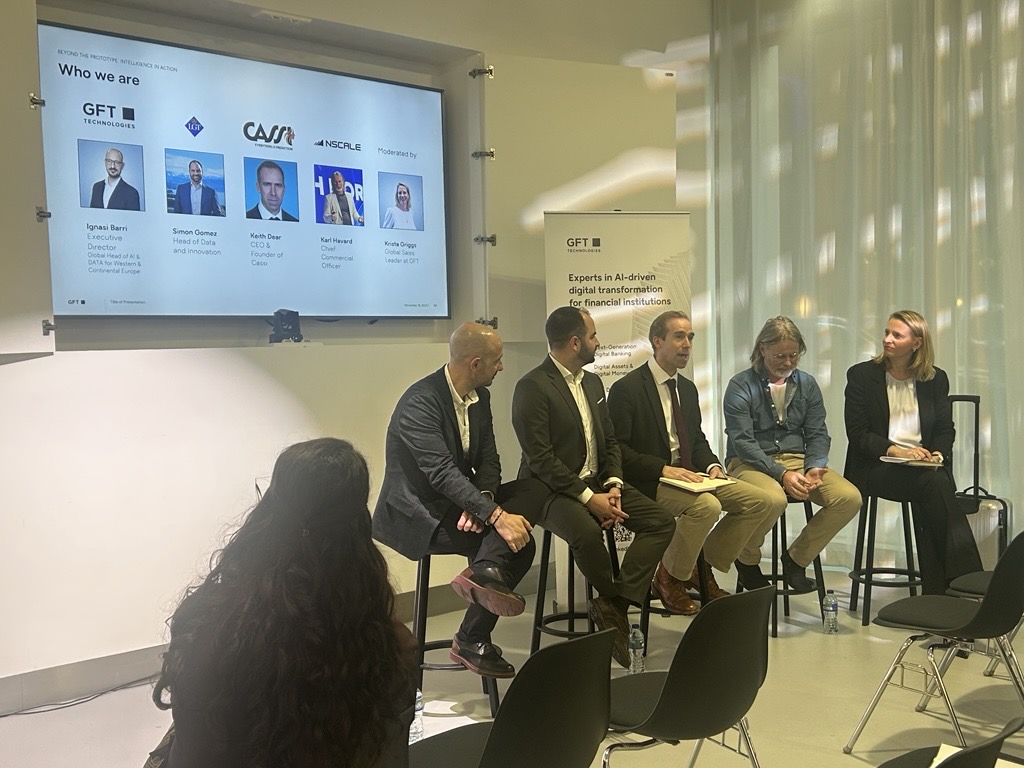
The financial services industry stands at the threshold of a fundamental transformation driven by successive waves of artificial intelligence. I recently had the pleasure of hosting four experts from different industries to discuss this very topic. Together, we explored the impacts on the banking industry from Generative AI, Agentic AI, and Physical AI, and I share some of their insights and recommendations here: strategic imperatives, including forging external partnerships, reengineering processes, investing in sovereign infrastructure, embedding governance, and addressing human factors. As Keith Dear notes, “There were two studies … one from Wharton saying 75 or 76% of GenAI adoptions generate positive returns, then another from MIT saying 95% of GenAI projects fail and deliver no value whatsoever,” illustrating the gulf between promise and practice and the need for strategy.
The waves of change rolling in
Artificial intelligence now infiltrates every corner of the banking value chain.
- The first visible wave consists of generative models that draft communications and give voice to data.
- The second materialises as agentic helpers that plan, decide, and execute sequences on behalf of people.
- A third lurks on the horizon: physical intelligence incarnated in autonomous vehicles, robots, and drones that interface with commerce and supply chains.
These waves present tangible use cases already alive today and invite reflection on what is at stake, what has been achieved, and what remains to be done.
Generative AI promises to accelerate cognition, augment creativity, and unlock productivity. Yet adoption reveals stark dichotomies. Some reports indicate that three-quarters of projects generate positive returns; others find that 95% deliver no value. The truth may lie in the long tail: a tiny fraction of pilots, perhaps 5%, generate millions in revenue while most languish half-formed.
External partners shift outcomes: as Keith Dear observes, “Partnering with external companies was much more effective than doing it internally”. Internal pilots encounter resistance as Simon Gomez is very familiar with. External engagement can double ROI compared to insular approaches.
As Karl Havard shared: “We work across many different sectors, and we’ve been working very closely with the UK government. They’ve rolled out Co-Pilot, and introduced “Humphrey,” their own internal AI Agent, which is great, but there is still a long way to go before they are truly AI augmented. This is where expert partners like GFT can help. They can offer expertise and genuine use cases where the use of generative AI and agentic AI has proven productivity gains and also develop more creative products and services to offer new ways of working, serving their users better. The CIO must match ambition with capability: set measurable objectives, align resources, choose complementary partners, and set a realistic pace. Failure to act creates cognitive burden, as Dear warns, “Most people can’t even begin to engage with the rate of change”. , revealing that intellectual agreement often coexists with operational inertia. “There is still a real desire to say it’s just hype, but the evidence shows us that it’s not.”
“We have examples of where AI has hit production in banking, like credit risk, claims resolution, contact centre, and many other areas,” notes Ignasi Barri. “Experimentation is great to understand the technology, but you don’t want to jump into pilots without understanding what you’re trying to achieve. Without a clear business case (with expected ROI), it stops solutions from getting into production.”
Agentic: The helpers get smarter
The next surge of innovation comes from agentic systems. Unlike generative models that wait for prompts, agents plan, decide, and execute operations autonomously, compressing hours of human labour into seconds. Benchmarks demonstrate that modern agents accomplish complex tasks in roughly thirty seconds that once consumed an hour; forecasts suggest they may replicate a human working year by 2029, with capability doubling every four months.
The implications for banking are urgent: which repetitive workflows (underwriting, trade reconciliation, compliance screening) can be delegated to agents today? Transformation demands a holistic audit of the value chain, shedding legacy assumptions and co-designing workflows with intelligent helpers. Embrace agentic systems as collaborators rather than mere tools to strip away inefficiency and unlock capacity. As Simon Gomez explains: “When we implemented our innovation factory, we talked very openly from the beginning about the pilots and approaches. We had a small group test the solution and provide feedback to deliver the quality our users want. This brought out not just the possibilities but also the risks and the constraints we face right now. There is a fear of adoption, but by ignoring it, we will not drive more adoption. More of my work is not the technical but the human element. Openly having the dialogue about adoption with senior management and the intentions for the AI. If you neglect that part, you will never drive adoption. Working in partnership with GFT complemented the skills of our IT department to accelerate adoption.”
“There is a lot of 'AI agent-washing',” adds Ignasi Barri. “The technology isn’t quite there yet. There are many solutions that are not agentic. From a commercial perspective, they are amazing, but they do not operate independently. There is a struggle at the C-level because they worry that they don’t have a single agent in production. But in reality, having agents that impact your operations is not that easy.”
Physical: When the digital becomes tangible
A third wave anchors intelligence in the material world. Autonomous trucks ferry goods across continents; robots assemble components; drones survey property.
Although banking may appear abstract, its tentacles extend into trade finance, supply chains, and the insurance markets that underpin them. Risk profiles change when conveyances navigate without human pilots; underwriting criteria require reconsideration when warehouses operate unmanned; collateral values and indemnities shift when the insured entity is a robot instead of a person.
Ignasi Barri observes that “We’re involved in building the AI platform for a European robotics company. They’ve just set up a whole robot gym in Guangzhou.” Karl Havard adds that “China is very focused on physical AI, where billions are being spent on many physical environments.” Treat physical AI as an emerging domain that intersects banking at supply nodes, requiring cross-disciplinary cooperation, new risk models, and a willingness to underwrite unfamiliar perils.
Business transformation: Beyond the pilot light
Incremental improvements are not enough. True transformation demands a fundamental rethinking of core processes and a willingness to embrace calculated risk. Without reengineering, automation only delivers marginal efficiency gains, not real value creation. Identify high-leverage investment areas, reimagine workflows around the capabilities of generative and agentic intelligence, and abandon brittle legacy practices.
As Simon Gomez states, “I believe that if you stop right now, with everything we have at hand, we can do incredible things. The real economic impact that we can achieve is fantastic. AI is solving problems today. It’s about moving into the return on investment, where we can see stronger effects. We need to rethink the processes and re-engineer them with the new tools at hand. That means bolder approaches. We need to explore how AI and humans work together to complete the jobs to be done.”
And Ignasi Barri reinforces this point, “Efficiency gains are not being generated immediately. In the beginning, you may see worse results when using AI. As long as you persevere … that’s where you are seeing the impact. AI needs to be part of the strategy, so you can identify low-hanging fruit, repetitive tasks, and edge cases to get early successes.” Persistence and executive mandate create the environment for change. The CIO must lead by aligning business units behind a shared vision and committing resources to iteration.
Sovereignty, regulation and governance
Banks operate in a heavily regulated ecosystem; AI increases the complexity of compliance, jurisdiction, and sovereignty. Karl Havard explains, “You can’t develop any of this without the infrastructure to deliver it on. The data centres of old are not fit for purpose to house NVIDIA GPUs. The energy demand is probably 10 times that of traditional CPU-based equipment. You’ve got to find the energy supply to support that. The energy demand for new specialist data centres will be more than the current UK National Grid can provide. Companies like Nscale exist because we’re building out a true sovereign AI infrastructure, powered by 100% renewable energy, offering our customers a truly dedicated private cloud, which allows them to train, tune, and inference their own model; they own the keys.” Sovereign AI is essential; Keith Dear agrees, “Every nation should have control over its own infrastructure. Better data equals better decisions and gives a competitive advantage. There is no upper limit to intelligence.” As Havard states, “You can’t limit intelligence – it's energy that will be the limiting factor”.
Regulatory uncertainty complicates platform design: “Innovate too fast, and you create platforms that can never be fixed; innovate too little, and you get left behind,” notes Simon Gomez. Embed controls and safeguards from inception: encryption and identity management as core design; interpretability and auditability as hard constraints; privacy, fairness, and ethics encoded at the model level. Anticipate liability across digital and physical domains: define responsibility for malfunctioning agents and devices up front, engage legal counsel early, and adopt anticipatory compliance rather than retrospective patchwork.
Psychology, resistance, and the human element
Human factors determine whether technical advances translate into business outcomes. Confronting unprecedented change produces cognitive dissonance; it is possible to agree with a strategic narrative yet “carry on as if nothing happened”, observes Keith Dear. “Every decision is a prediction: if we do X, then I expect Y to be the outcome. Strategies, tactics, and plans are the same, just on a bigger scale. AI is forecast to outperform humans in prediction in 2026. I don’t think many organisations have begun to consider the profundity of what that means at all levels of corporations - which are in a sense decision machines”. Resistance stems from existential fears and organisational antibodies that extinguish experiments: as Gomez knows well, “It’s very easy to launch an internal pilot, and then all the antibodies try and kill it”. As Harvard puts it: “There’s a big element of risk here. Where we’re seeing the most adoption is where companies are prepared to take risks, have a go, and see what happens, plus how fast you can work using agile ways of working. If you look at comparative nations, Europe is naturally slightly more risk-averse than the US, China, and the Middle East. The latter are smashing through the barriers.”
Overcoming these barriers demands behavioural change, executive mandate, and cultural evolution. Invest in digital literacy and behavioural training; support psychological safety for experimentation; celebrate failure as a source of learning; appoint cross-silo champions accountable for adoption. Reimagine work architecture alongside code architecture: adjust job descriptions and incentives as human agents collaborate with artificial colleagues; accept that literacy in machine behaviour is as elemental as numeracy.
Is your AI Strategy built to last?
Follow these 8 moves to future-proof your business, and partner with GFT to execute them at scale.
- Define outcomes & align resources: Set explicit objectives and align people, capital, and technology.
- Partner externally: Leverage specialist organisations to boost success rates.
- Reengineer processes: Identify tasks for AI delegation and redesign workflows.
- Invest in sovereign infrastructure: Secure sensitive data and control jurisdictional exposure.
- Embed governance: Integrate controls, interpretability, and ethics from the outset.
- Cultivate human capital: Prepare teams through targeted education and incentives.
- Adopt a long-term mindset: Commit to iterative improvement and transparent progress reporting.
- Expand domain awareness: Understand the interplay between finance, supply chains, and physical infrastructure.
AI’s progression from generative prototypes to autonomous agents to physical manifestations is inexorable. It requires reframing the banking model, challenging assumptions, and concerted effort across technology, business, and compliance. The CIO’s role transcends traditional boundaries: integrator, navigator, and storyteller. Actively build feedback mechanisms; embed AI literacy into governance; report progress against measurable milestones; evolve risk frameworks; and maintain a global perspective to draw lessons from early movers.
As Keith Dear notes: “We’re talking here about fundamentally automating huge chunks of what you do every day.” The challenge is to harness AI deliberately as the engine of enduring value, shaping the future rather than succumbing to it.
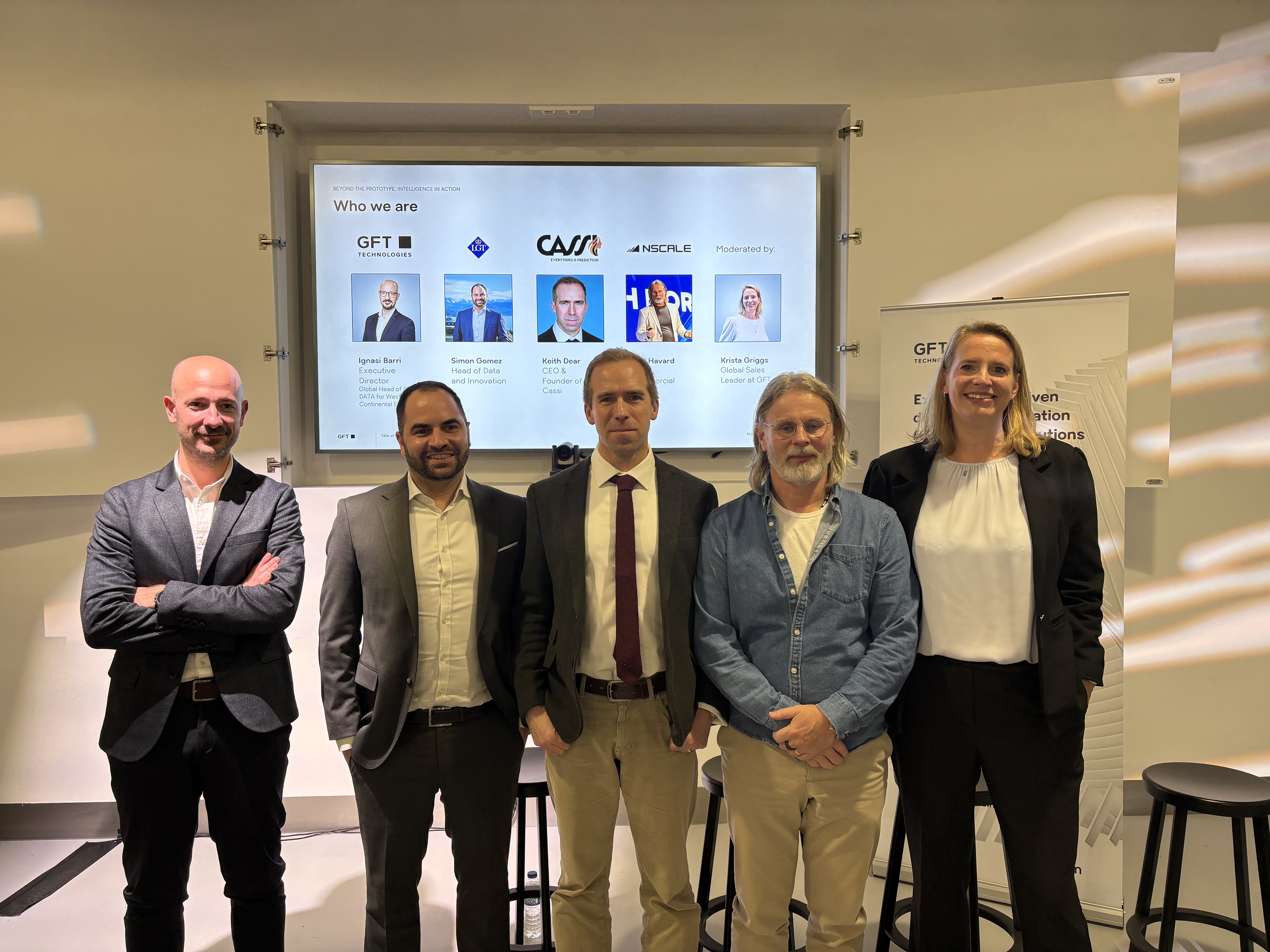
A special thanks to our fantastic speakers and industry experts for their insights and support:
- Keith Dear, Founder & CEO at Cassi AI - https://www.linkedin.com/in/kdear/
- Karl Havard, Chief Commercial Officer (CCO) at Nscale - https://www.linkedin.com/in/karlhavard/
- Simon Gomez, Head of Data and Innovation at LGT Private Banking - https://www.linkedin.com/in/simon-gomez-cfa-8b2b5227/
- Ignasi Barri Vilardell, Executive Director, Global Head of AI & DATA at GFT Technologies - https://www.linkedin.com/in/ignasibarri/
Got questions? We’re happy to help.