Guidewire’s latest announcements fit squarely into that momentum. The company has clearly entered a new phase, leaning fully into intelligent automation, modular architecture and modern development practices.
Guidewire has been observing the growth of AI for years. They have seen how valuable it can be. Now, they are focused on a clear goal: "Intelligent Insurance."
And that’s what stood out this year: not just new features or product updates, but a strategic shift. Guidewire is changing how insurers will price, underwrite, build and operate in the next ten years.
The Rise of Intelligent Insurance
Many people in our field know that Intelligent Insurance is not just a concept. It is becoming the basis for how carriers work. Guidewire sees AI as central to modern insurance. It is not a disruptive force, but a strong tool that helps the whole value chain.
The message is clear and consistent: AI exists to elevate people, not replace them. It enhances decision-making for underwriters, accelerates development cycles and reduces time spent on repetitive, low-value tasks. Whether it’s generating test cases in seconds or supporting complex risk evaluations, AI is unlocking new levels of efficiency and precision.
This aligns perfectly with the direction of the entire industry. Across major insurance and Insurtech gatherings, the theme is the same : AI is about empowering teams to focus on what truly matters. It creates space for strategy, creativity and expertise to shine.
Guidewire’s recent acquisition of ProNavigator, an AI-powered knowledge management platform and estimated GFT partner, reinforces this commitment. Through ProNav’s AI-driven platform, Guidewire enhances how teams access information, make decisions and streamline operations across the insurance lifecycle.
Major Product Announcements: PricingCenter and UnderwritingCenter
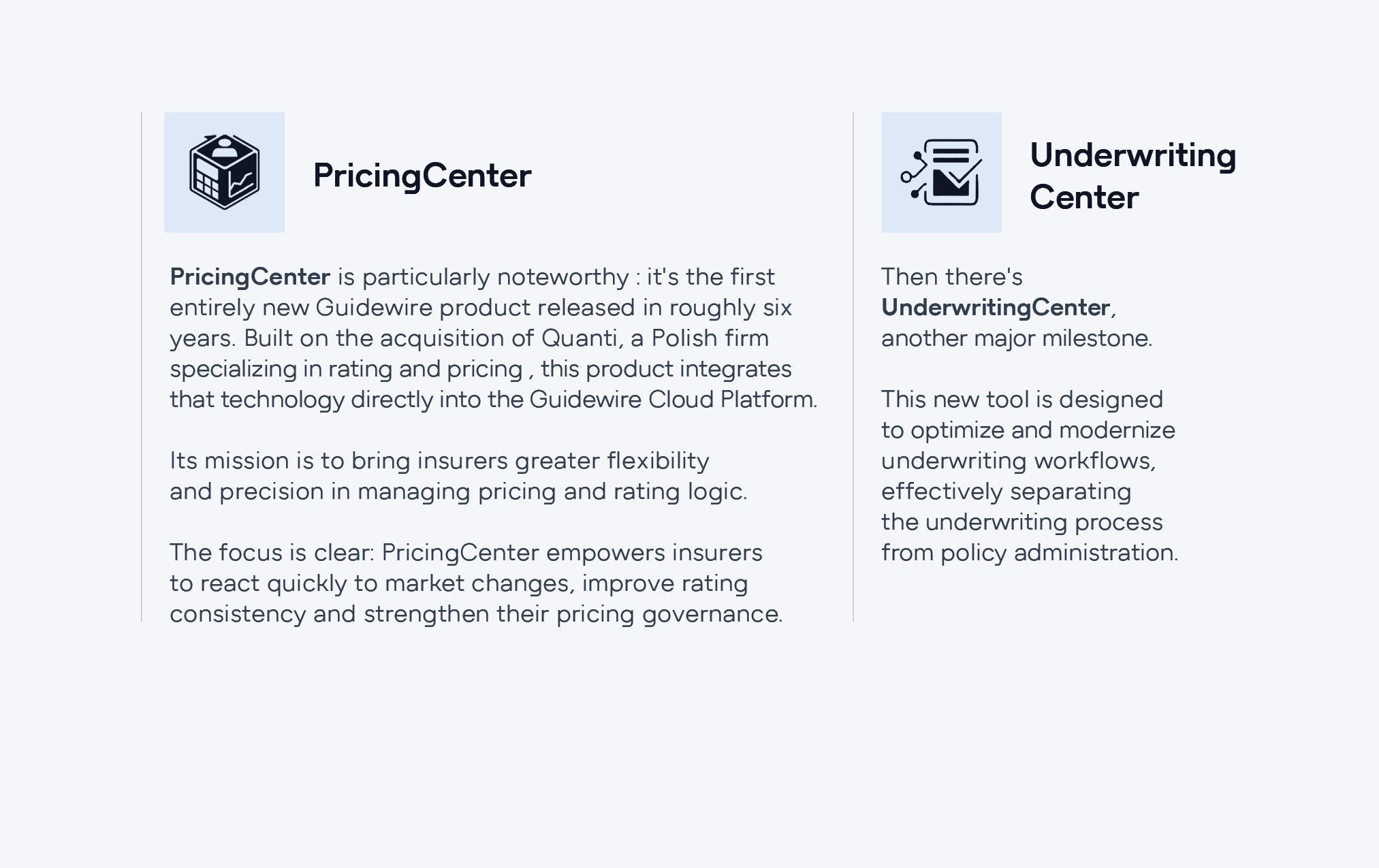
Beyond the AI story, Guidewire also delivered big on the product front. This year marked the official unveiling of two major new components: PricingCenter and UnderwritingCenter.
In simple terms, Guidewire is refining PolicyCenter’s structure to highlight two distinct but complementary parts:
- UnderwritingCenter for submissions, evaluations and decision-making;
- PolicyCenter for ongoing policy lifecycle management.
This move makes the overall platform more modular and flexible. Insurers can evolve their underwriting processes independently, accelerate change cycles and reduce deployment complexity. It’s a game-changer for teams that want agility without breaking what already works.
A Shift in Technology: Beyond Gosu
One of the biggest ongoing questions in the developer community has been whether Guidewire would eventually move away from Gosu, its proprietary programming language. At Connections 2025, we finally saw that transition taking shape.
Therefore, Guidewire’s new products are being made with modern, open technologies like Python, Java and TypeScript.
To give a few examples:
- Intelligent Gateway (IG) → Runs on Java;
- Autopilot → Built with TypeScript.
This signals an important shift : Guidewire is modernizing its stack, opening the door to broader developer communities and making integrations easier than ever.
Gosu isn’t disappearing, but it’s no longer the center of innovation.
For insurers, this means faster innovation cycles and easier hiring. For developers, it means working with tools and languages they already know. And for the Guidewire ecosystem, it means a smoother path toward modernization.
The Human Side of AI
While the technology news was exciting, what resonated most for me was the human message at the heart of all these announcements.
Guidewire, like the broader industry, is reinforcing that AI is not a replacement strategy, it’s an enablement strategy. For developers, AI will take care of simple, repetitive tasks like test generation and bug detection. This will give them more time for creativity and design. For business users, it’s about better insights and automation that make decision-making faster and more accurate.
Efficiency is the keyword, not replacement. This balance between human expertise and machine assistance will define how insurers operate in the years ahead.