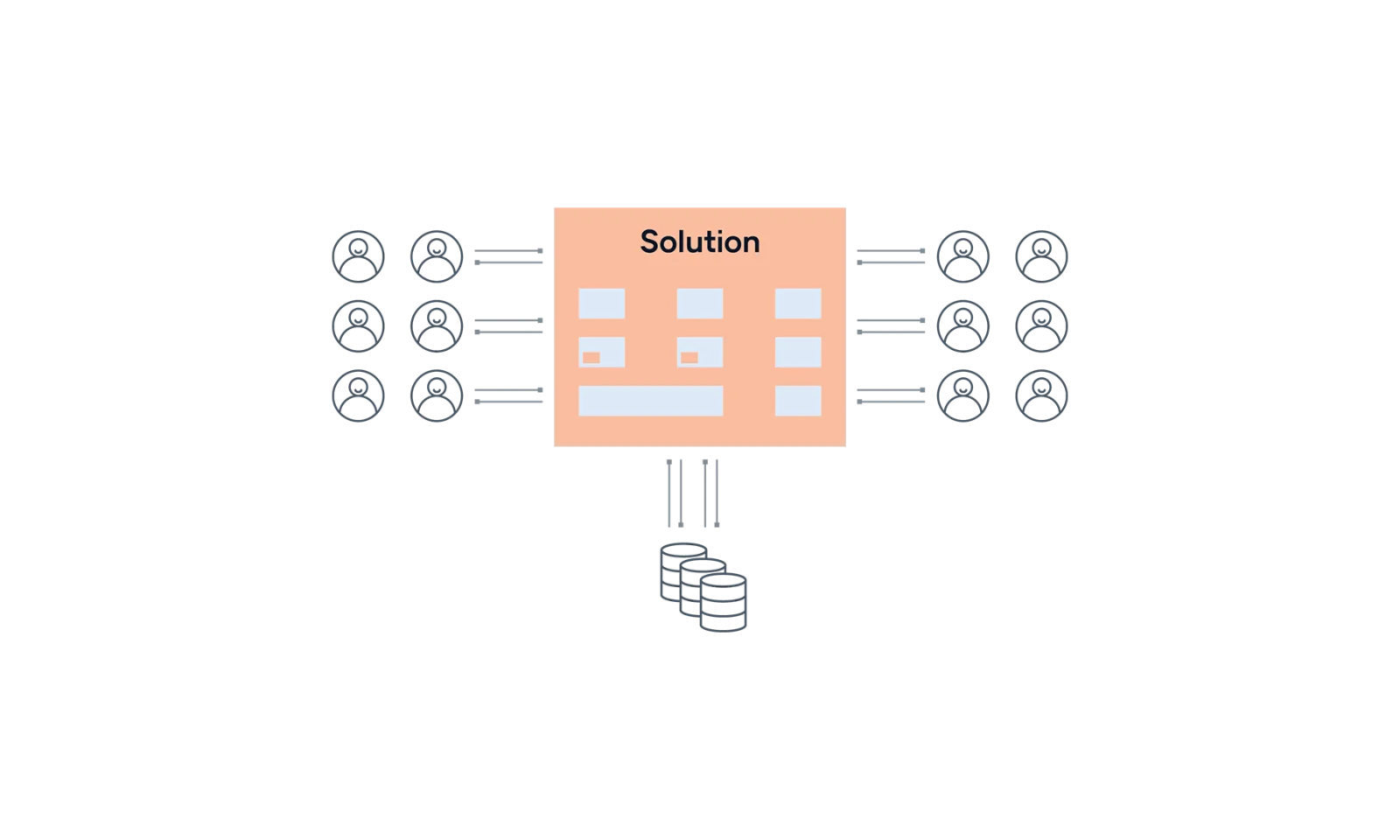
Using the example of an AI solution to automate marketing, after selecting valuable use cases, we have identified that a model could be built to predict customer churn. This fits firmly into traditional AI (ML), but the same approach could be applied if the technology happened to be generative AI. Leaving aside the details of building such a model, it appears to work well, in that it can successfully predict if a customer is likely to churn (even evaluating a model’s performance depends on the business application, and this should be agreed in advance with the relevant stakeholders). Assuming that the engineering considerations have been successfully addressed, such as integrating it with the data and existing infrastructure (the effort required should never be underestimated in a project), we still need to ensure that such a model really adds value to the business.
Going back to the theme of our previous article, we also want to ensure that we do not work in a vacuum. Therefore, to ensure that the end result delivers the impact desired and anticipated, rather than being seen as a solution looking for a problem, it is necessary to continue to work with the senior stakeholders and end users to make sure that this actually happens. In this case, after working with the relevant stakeholders, the way to bring value to the business might be to make the outputs of the model available to marketers within the company so that they can specifically target individuals who are likely to churn.
One key consideration for users interacting with the output from ML models is to ensure that it is useful to them. For example, it is likely to be integrated into some sort of marketing UI, but then what would be a useful presentation of the data? Probabilities from 0.0-1.0 are unlikely to make sense and be valuable by themselves, but how about high/medium/low, or even top N or top N% most likely to churn. Here, as you can see, decisions need to be taken throughout the process, in close collaboration with relevant stakeholders, to ensure that the project achieves a useful result.
Surfacing the model output to marketers in a way that is useful to them would give us a way to demonstrate the value of the model and to get buy-in from the user (which could then lead to further automation or building it into an end-to-end solution). This neatly illustrates the twofold benefit of working closely with users and senior stakeholders to not only validate the value of the solution, but also to serve as a checkpoint which can lead to increased project scope or greater investment.