Intelligence as a Variable Cost
For the first time in history, cognitive output has a measurable unit cost. Need a first draft of a market analysis? That costs a few thousand tokens. Want to summarize 200 pages of regulatory filings before your Monday meeting? A few thousand more. Need to debug a Python function or document a legacy COBOL-based system? That’ll be a quarter to half a million tokens.
This changes the economics of thinking within organizations. Intelligence is no longer tied to headcount. It’s elastic. It’s on demand. And companies that learn to allocate it wisely will outperform those that don’t—not by a small margin, but by an order of magnitude in speed and adaptability.
The question for leadership is no longer, “Do we have enough staff to handle this?” but rather, “Are we spending our tokens on the right problems?”
The Augmented Employee Is the New Competitive Advantage
A developer who knows how to make effective use of 10,000 tokens will outperform a team of five who don’t. Professionals who integrate AI into their workflows aren’t just faster—they operate on an entirely different level. An HR leader who deploys tokens to screen, match, and onboard talent is compressing weeks into hours.
This is the empowered worker. Not replaced, not threatened—augmented. Professionals who understand how to leverage tokens become disproportionately valuable. Retention strategies must now reflect this. Compensation models will follow. Organizations that provide their people with the best token infrastructure—the tools, access, and training—will attract the kind of talent that multiplies results rather than simply adding to them.
Access to tokens is already becoming a talking point in employee benefits discussions. Honestly, I don’t think that's an exaggeration.
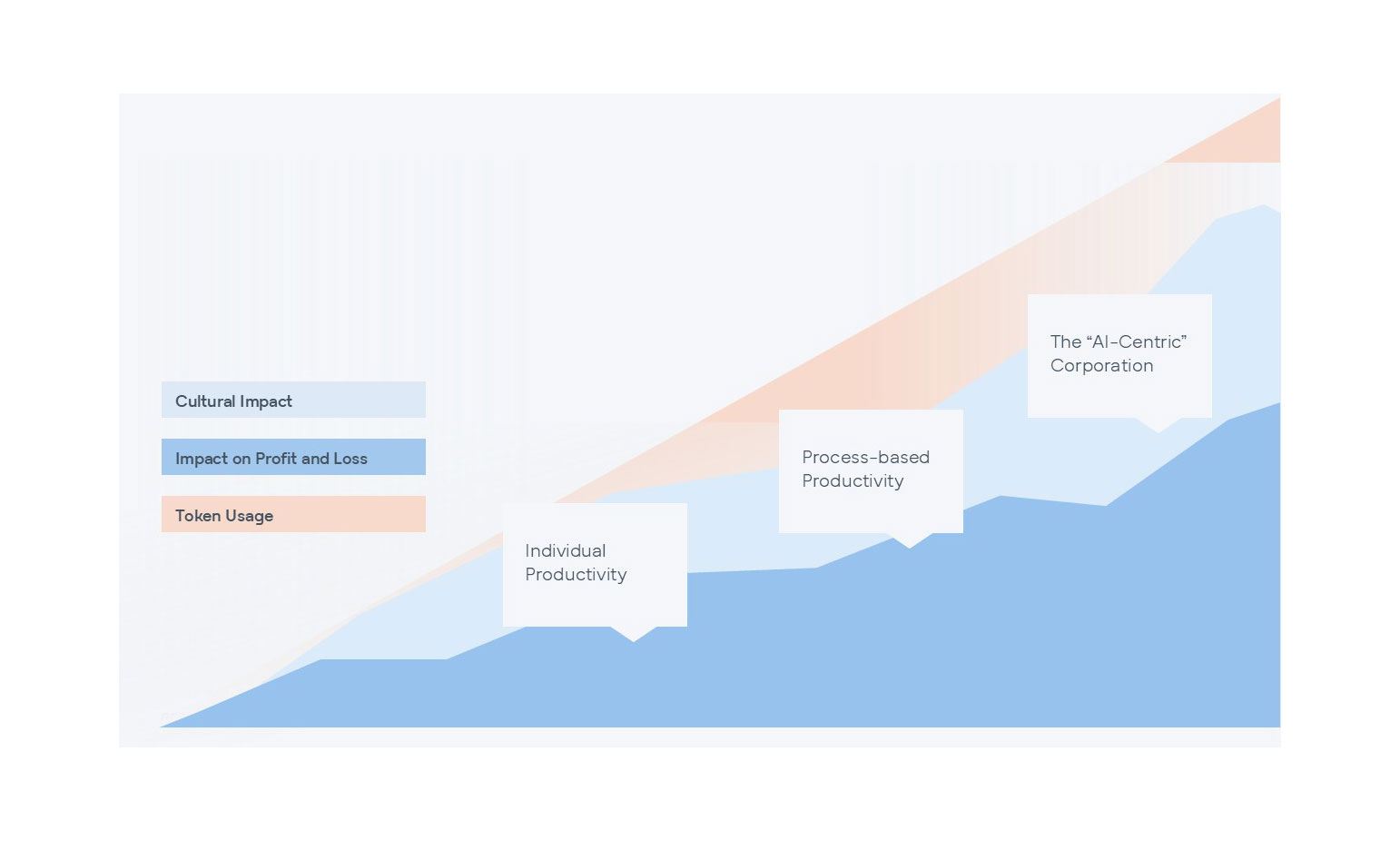
The Three Stages of Token Maturity
Stage One: Individual Productivity
This is where most organizations are today. Use cases range from drafting emails to summarizing documents to generating code. Token consumption is scattered, bottom-up, and largely invisible to leadership. The value is real but limited: one person, one task, one result at a time.
It’s powerful —but it’s the floor, not the ceiling.
Stage Two: Process-Driven Productivity
This is the tipping point. Companies stop viewing AI as a personal productivity hack and begin integrating it into core workflows. Onboarding, customer support escalation, financial reporting, contract review —entire processes are redesigned with AI woven into every step. The gains are not incremental; they are structural.
The organization becomes smarter at the system level.
Stage Three: The “AI-Centric” Corporation
This is where true transformation happens. Tokens are not added to existing processes; the operating model itself is built on native AI principles. Decision-making architectures evolve. Organizational structures flatten. New roles emerge. Old ones evolve until they become unrecognizable. The company doesn’t “use” AI —it operates with intelligence as a utility.
Very few companies have reached this stage yet (and if yours has, I'd love to hear from you).
Most companies believe they are further along this path than they actually are. Being honest about where you are is the first step toward reaching the next stage.
The Four Dimensions of Tokens in Corporate Strategy
If I had to distill this into a working model for any executive team, it would come down to these four questions:
Token Allocation
Where is your AI spending going, and is it aligned with your strategic priorities? Over the next 6–12 months, token budgets will require the same rigor as any other resource allocation.
Token Literacy
How skilled is your workforce at turning tokens into value? This isn’t about prompt engineering courses. It’s about a culture where people know when to turn to AI and when human judgment is irreplaceable.
Token Infrastructure
What systems, security protocols, and platforms are you building to ensure that token usage is secure, compliant, and scalable? It’s not the most glamorous part, but it determines whether your AI initiatives thrive or stagnate.
Token Culture
Does your organization see tokens as a threat or as a lever? The cultural stance you establish today will determine your adoption speed over the next decade.
This Isn’t About AI. It’s About Operating Models.
The conversation about tokens isn’t purely technological. It’s a conversation about organizational design. A conversation about talent strategy. A conversation about capital allocation.
Companies that treat tokens as “just an IT issue” will fall behind. Those that treat them as a core strategic input—as essential as capital, as measurable as revenue, and as cultural as values—will define the next era of corporate performance.